
Choosing a Ski Travel Bag: Sizing, Car, Train, Plane, and Storage
Choosing a Ski Travel Bag: Sizing, Car, Train, Plane, and Storage
Choosing a Ski Travel Bag: What to Check
Most people stick with what they know: a bag for flying, a box or rack for driving, and nothing in between. Single-purpose gear solves one trip. The real question is not” Will my skis fit?” It is “Will this bag work for every way I travel?” Here is what to look for.
Measure Before You Buy
Ski length and width are printed on the topsheet in centimeters. Most people check the length and stop there, but width is equally as important. All-mountain and powder skis can run over 100mm underfoot.
Most adult skis fall between 150cm and 195cm, which is why the best ski bags come in sizes, not one universal fit. Too big, and your skis shift and knock around in transit. Too small, and the bag won’t close. Most damage happens on the way to the mountain, not on it. Get the size right, and your skis arrive in the same shape they left.
Match the Bag to How You Travel
By Car.
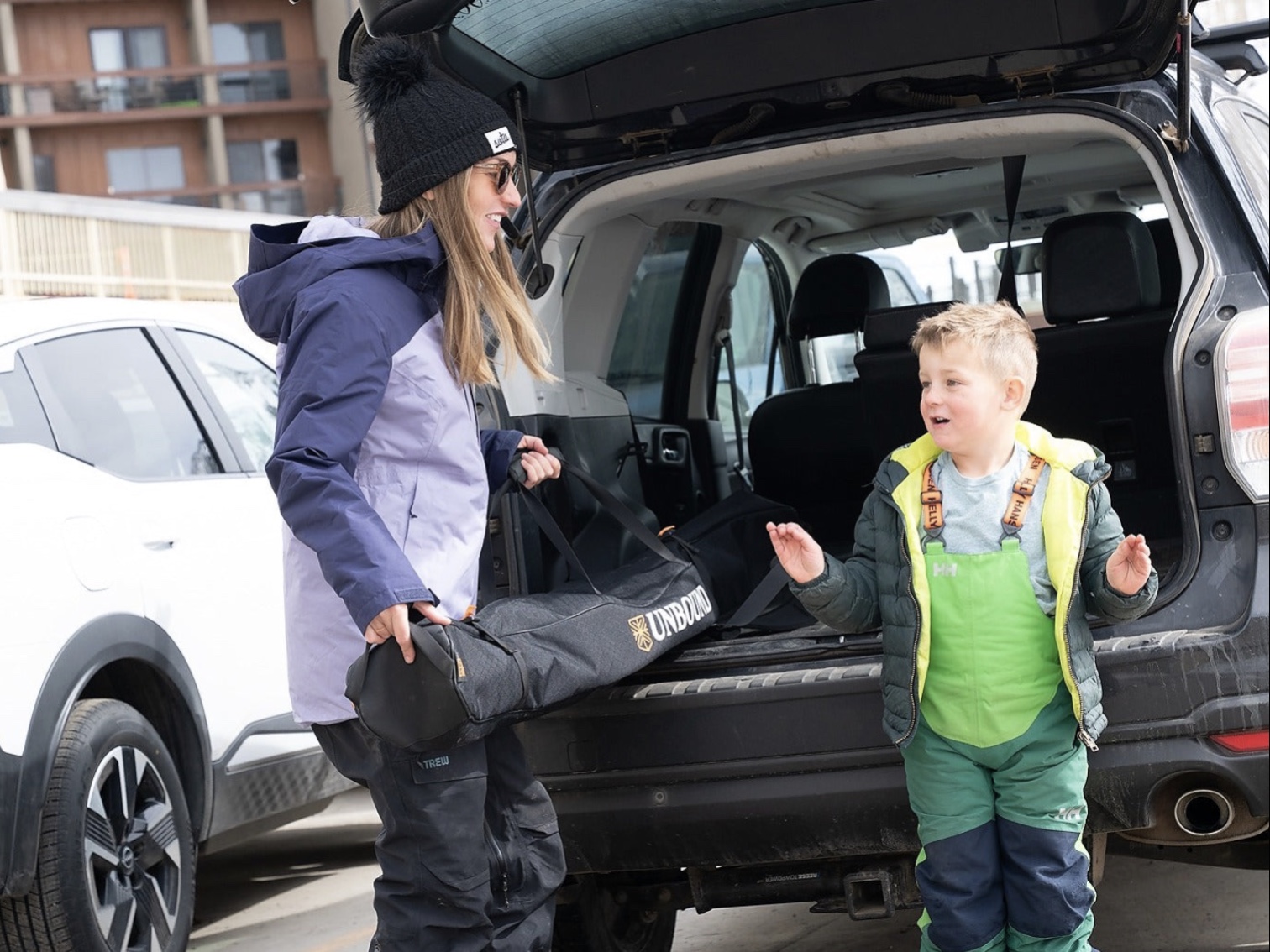
If you skis ride on a roof rack or hitch rack, the bag needs to be built for it, not just tolerate it. A bag shaped to the natural profile of your skis sits tighter against the rack and cuts wind drag on the highway.
If your skis go in the trunk instead, bulk is the problem. A heavily padded ski bag built for air travel takes up valuable space in your car.
A rule for the road:
- Hitch racks anywhere: Make sure your license plate and lights stay visible
By Train
Taking the train to the mountains is growing, especially in Colorado where the Winter Park Express runs from Denver Union Station straight to the base of Winter Park Resort. Amtrak requires skis and poles to travel in a bag or hard-sided case, whether you carry them on or check them. Carry-on skis are capped at 50 lb and 72 inches, (183cm). Checked skis have the same 50 lb limit and a 75 linear inch cap, with an oversize fee for anything from 76-100 inches, (193 to 254 cm).
For train travel, a ski bag isn’t just convenient, it’s your ticket on board.
By Train in Europe:
Rules vary by country, but the pattern holds: skis usually ride free, and they almost always need a bag.
- Eurostar: On standard routes, skis count as one of your two pieces of luggage and are not held to the usual 85cm size limit. The Eurostar Snow service to the French Alps (connecting in Lille) goes further, allowing one pair of skis on top of your two-bag allowance, with no weight limit.
- SBB (Switzerland): No weight or size limit for skis carried on board, and several routes into the Alps have ski racks built into the carriages.
One consistent rule: skis need a protective bag that covers them fully.
By Plane
Flying is a different situation entirely. Unite’s policy states it “is not liable for damage to water ski, snow ski, or snowboard equipment,” and other major carriers have similar exclusions. Some airlines waive oversize fees for ski gear, but a fee waiver is not a damage guarantee. On international flights, the Montreal Convention caps baggage claims at 1,519 SDRs (about US $2,000) per passenger. If your skis are getting checked, real structural protection is not optional.
- US: Delta counts a ski bag (with skis and poles) plus one separate boot bag as a single checked item, with a combined 50 lb limit. Bags over 115 linear inches (292 cm) are not accepted.
- US: Southwest counts a ski bag (with skis and poles) plus one separate boot bag as a single checked item; The oversize fee is waived for qualifying ski equipment, but free checked bags now only apply to certain fares and loyalty tiers.
- Europe and Canada: Ryanair takes skis in the hold for a fee, up to 20 kg per item. Air Canada requires skis and poles in a rigid or hard-shell case and counts poles packed separately as an extra piece.
Policies change and vary by carrier, so check your before you pack.
Keep Your Poles Protected
Most ski bags treat poles as an afterthought. A bag that holds skis and poles together, with interior buckles keeping everything aligned, means no separate pole bag and no poles rattling loose. Pack them once, and they stay put, whether the bag is sitting still, hanging, or slung over your shoulder in the parking lot.
Off-Season Storage
Most ski bags spend the off-season crammed in a close or tossed in a corner of the garage. A better bag compresses flat when empty and hangs on a standard wall-mounted ski rack, so it doesn’t take up more space than your skis already do.
Quick Checklist
- Ski length and width: Printed on the topsheet. All-mountain and powder skis can run over 100 mm underfoot.
- Size tiers vs. one-size fits all: Loose gear in an oversized bag is how damage happens.
- Roof rack or trunk: A rack-built bag sits tight and cuts wind drag. A heavily padded airline bag takes over your trunk.
- Train (U.S.): Amtrak requires a bag or hard-sided case. Carry-on max is 50 lb and 72 inches, (183 cm).
- Train (Europe): Eurostar counts skis as one of your two bags on standard routes and adds a free pair on snow trains. SBB has no weight or size limit on board. A full protective bag is required.
- Air travel: Airlines limit liability for ski gear, and international claims cap at about US $2,000. Real protection matters more than a size-compliant shell.
- Poles: Skis and poles in one bag, held in place with interior buckles. No separate pole bag needed.
- Storage: Compresses flat and hangs on a standard wall-mounted ski rack, taking up no more space than your skis already do.
One Bag for Every Trip
The WinterProof Bag mounts to roof racks and hitch racks, then converts to a backpack, duffle, or hand-carry bag for everything else: the car, train station, the airport, and the walk to the lift.
Three sizes fit all-mountain skis and powder skis, from 150 cm to 195 cm and up to 124 mm underfoot.
Skis and poles pack together in one bag, and interior buckles keep them aligned, so nothing shift whether the bag is stationary, hanging, or in motion. The external shell resists road salt and de-icing chemicals. At season end, the bag compresses flat or hangs on a standard wall-mounted ski rack instead of taking over your closet or garage.
Not sure what size fits? Check the Quick Start Guide, or read how to choose a ski bag as a gift.
FAQs
How do I know what size bag to buy?
Check the topsheet. Length and width are both printed there in centimeters. Most adult skis fall between 150 cm and 195 cm, and all-mountain and powder skis can run over 100 mm underfoot.
Do I need a bag to bring skis on a train?
Yes. Amtrak requires skis and poles in a bag or hard-sided case, carried on or checked. Carry-on skis can’t exceed 72 inches (183 cm) or 50 lbs. Checked skis have a 50 lb weight limit and a 75 linear inch cap, (191 cm), before oversize fees apply.
Do European trains have the same ski rules as Amrak?
Not exactly. Eurostar counts skis as one of your two bags on standard routes and adds a free pair on snow trains. SBB sets no size or weight limit for skis on board. One consistent rule is a full protective bag.
How do I protect ski poles during travel?
Pack them inside the same bag as your skis, secured with interior buckles instead of strapped to the outside. That keeps them aligned and out of the way of other gear.
Where should I store a ski bag in the off-season?
Anywhere you have room. A bag that compresses flat when empty fits into tight spaces like a closet shelf, under a bed, or the garage. Or, hang it on a standard wall-mountain ski rack alongside your skis, so it does not take up any extra space at all.
Does a ski travel bag protect against airline damage?
The bag is your protection, not the airline. United outlines that it is not liable for damage to ski equipment and other carriers have similar exclusions.
More adventurous
The Outdoors Have a Story to Tell.
Ski length and width, pole protection, car, train, airline rules, and off-season storage. What to check before you buy a ski travel bag.
You don’t have to be a skier to give a ski bag as a gift. All you need to know are the right questions to ask. Here is an overview of what to consider.